Showing posts with label life cycle. Show all posts

Wednesday, September 2, 2009

Life Cycle Thinking

In my readings, I came across an old article about a cause I once supported during my college days. I guess I had previously written about it in an earlier post. I once supported a popular civil society group in convincing some big fast food company to switch from polystyrene to reusable wares. It was a victory on our part because gradually, the fast food company's ware did change part of their dine-in customers. However, after a decade, these fast food who once got acclaim for their effort in shifting are now condemned as polluters of our waterways because the cost to clean up their effluents is still not present. The point is we should never look at one thing and think such is a great thing, environmentalists still haven't caught up with life cycle thinking. 


I guess this is my problem being most of the time a consultant more than being an advocate which is every now and then. Sometimes, I just know too much because I have been in both sides of the fence, before lobbying for stricter environmental regulations and working for an industry requesting for a compliance holiday. But the point is what matters is our overall impact.

Ever since we were born, we have always consumed resources. A professor who had passed away a year ago once told us in his lecture that it is much more energy efficient to die than to stay alive, wherever he is, he sure has reached a level of optimum efficiency. Looking at the chicken diagram, well I have eaten so many eggs and so many chicken in my lifetime and that consumption had supported the chicken farms, etc., etc.

Going back to the fast food sector, polystyrene packaging is not the only issue, not only waste water or its impact on the Amazon rain forest since most them outsource their beef from that region. We should know that all fast food corporations are made out of people, not in the "soylent green" sense but in the human resource sense. What drives these people to stick to their guns and continue on their unsustainable path is the way they think and how they see things and the need of their immediate customers. It will be quite a while but the transition is on-going.

Click Here to Read More..

Tuesday, August 25, 2009

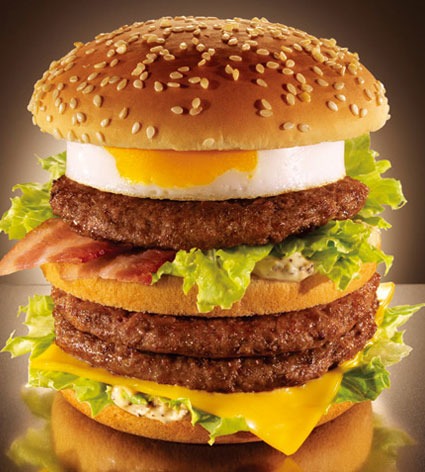
The Magnitude of This Burger Makes Me Think of its Environmental Impact

The first time I saw this picture of McDonald's MegaTamago scared me, not for environmental reasons but for health reasons. The burger is unbelievable unhealthy...3 patties, bacon and an egg.

This burger is only available for a limited time in Japan who among the world has a population with the longest life span. Beef and Japan is a truly ironic combination even the fact that some Japanese still believe that whale meat is a cultural delicacy. I'm just posting a picture, this is a complicated matter...

Click Here to Read More..

Monday, August 24, 2009

Locavores: Closer to Home

Is it colonial mentality that enables us to judge that imported is always better? Nowadays, the rule is imported is cheaper, especially if it came from India, China or Vietnam. But if we are told that a product came from Australia, New Zealand or Brazil, we might think otherwise, it might be better??? Where it came from is a relative term, how it came about is what matters.

When I think of Beef and Brazil combined, I think about the destruction of the Amazon Rainforest which leads to habitat loss of endemic species and loss of biodiversity and analyzing its impact further it will lead to climate change. In the Philippines, it is still not mainstream knowledge, but globally it is quite a concern and efforts by Brazil to claim sustainability in the cattle ranching industry is often criticized for being too greenwashed. The funny thing however for this case is the burger joint is not aware that it is proclaiming support against sustainable development. The truth is Beef from Brazil is Cheap and outsourcing beef from Brazil minimizes a burger joint's operating costs.


The globally expansive supply chain of the fast food is the reason why it is unsustainable. I once wrote that McDonald's insistence on the use of trawled Alaskan Pollack for its fillet-o-fish (even its insistence on carrying the Fillet-O-Fish in countries with little or no demand) not only causes impacts on the Bering Sea but also foregone benefits are accrued due to its failure to consider outsourcing fish from local aquaculture development in developing countries. It is only recently that I encountered the term locavore. If a carnivore eats meat, a herbivore eats plants, then a locavore eats local. Is localization an option for fastfood giants? However, this joint is closer to home.

Click Here to Read More..

Sunday, August 16, 2009

Is Basic Environmental Awareness Enough to Make Environmental Claims?

In relation to what I wrote earlier, establishing an EMS based on ISO 14001 does not require a highly technical set of environmental programs but more emphasis is done in the commitment of top management to improvements and adhering to a clear environmental policy.

However, branding a company as environmentally compliant without reference to any standard is blatantly a practice of Greenwashing. Though most local companies are not aware, a specific standard is present in the ISO 14000 series that gives specific/systematic guidelines on how to integrate the results of implementing an EMS into the product labeling or eventual marketing of the outputs of the production process.

ISO14020:2000 was developed to ensure that environmental claims are done in a responsible and technologically validated and verifiable manner.

Mere environmental awareness in not enough, oftentimes results of a Life Cycle Analysis is essential to know that what is being claimed by a specific product indeed is validated and verified.

A few moments ago while watching the news, I heard a congressman marketing the merits of a specific renewable energy source and dismissing the contribution of others. What came into my mind, given the corrupt nature of most traditional politicians, is that this congressman may have had a "kickback" in the investment and marketing efforts of the said renewable energy technology (mere impression only, no claims).

It is neither ethically nor empirically correct to simply dismiss the benefits of other renewable energy sources and proclaim one source as the best unless a full benefit-cost analysis is presented in due diligence.

As common consumers we would never fully know unless we take the full effort to research further on what are the impacts of certain products to our health, safety and the environment.

Click Here to Read More..

Wednesday, July 15, 2009

Wash VS. Styro

A current concern in the fastfood sector is the massive use of polystyrene packaging. In the UK and most of the developed world, there is already a gradual transition from the use of polystyrene towards more sustainable packaging materials.

When McDonald's reverted back to the use of polystyrene cups for its sweet tea, it received much criticism in for its corporate social responsibility (http://www.sustainableisgood.com/)

In the Philippines, the fast food sector still has a long way to go before it can fully transition towards more sustainable packaging. I am quick to note that I am not advocating the use of paper packaging but rather a packaging system with minimal impacts to the environment in the course of its life cycle. I have decided to write this blog in the context of the Third World since the truth of the matter is economic conditions locally is totally different from the developed world.

One of the challenges of the fast food at the moment is the impact of its transition from polystyrene packaging to reusable melamine wares for dine-in customers. The transition was once hailed by civil society as the first step towards a more sustainable fast food industry, with a number of press releases. I was still in college at that time in UPLB. I remember an email forwarded to me where a civil society group boycotted the offices of McDonald's since it didn't immediately follow suit with its competitor's move to reusable wares.

However, this shift has a catch, it did reduce the volume of polystyrene packaging wastes but for the past five years according to my boss, the waste water quality of the fast food was on a decline and the DENR is now reprimanding the industry for failing to comply to the water quality standards.
Technical solutions have been offered by a number of waste water treatment experts but none so far has been effective or let's say not so economically feasible given the space requirement, initial investment and maintenance cost over time.

Last December 2008, I attended a party of the Polystyrene Packaging Council of the Philippines, those invited where not merely the styro producers but a number of waste recyclers who made it a business to recycle polystyrene products. At that time, the municipality of Los Banos issued an ordinance banning the use of plastics and polystyrene packaging from all its establishments and other local governments are planning to follow suit. The DOST does support the recycling technologies but its environmental impacts should be assessed.

What I have learned is that every policy decision has an impact and my basic training in economics taught me that given this condition, we should optimize our options to come up with the solution with least cost or the least detrimental impact. Ideally, given this type of a scenario, a full Life-Cycle Analysis must be done but being in the Third World, we do not have the capacity in time and money to engage ourselves in this exercise.

Click Here to Read More..