Showing posts with label LCA. Show all posts

Wednesday, September 2, 2009

Life Cycle Thinking

In my readings, I came across an old article about a cause I once supported during my college days. I guess I had previously written about it in an earlier post. I once supported a popular civil society group in convincing some big fast food company to switch from polystyrene to reusable wares. It was a victory on our part because gradually, the fast food company's ware did change part of their dine-in customers. However, after a decade, these fast food who once got acclaim for their effort in shifting are now condemned as polluters of our waterways because the cost to clean up their effluents is still not present. The point is we should never look at one thing and think such is a great thing, environmentalists still haven't caught up with life cycle thinking. 


I guess this is my problem being most of the time a consultant more than being an advocate which is every now and then. Sometimes, I just know too much because I have been in both sides of the fence, before lobbying for stricter environmental regulations and working for an industry requesting for a compliance holiday. But the point is what matters is our overall impact.

Ever since we were born, we have always consumed resources. A professor who had passed away a year ago once told us in his lecture that it is much more energy efficient to die than to stay alive, wherever he is, he sure has reached a level of optimum efficiency. Looking at the chicken diagram, well I have eaten so many eggs and so many chicken in my lifetime and that consumption had supported the chicken farms, etc., etc.

Going back to the fast food sector, polystyrene packaging is not the only issue, not only waste water or its impact on the Amazon rain forest since most them outsource their beef from that region. We should know that all fast food corporations are made out of people, not in the "soylent green" sense but in the human resource sense. What drives these people to stick to their guns and continue on their unsustainable path is the way they think and how they see things and the need of their immediate customers. It will be quite a while but the transition is on-going.

Click Here to Read More..

Tuesday, August 25, 2009

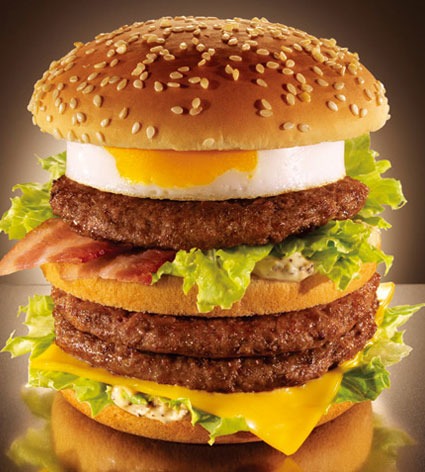
The Magnitude of This Burger Makes Me Think of its Environmental Impact

The first time I saw this picture of McDonald's MegaTamago scared me, not for environmental reasons but for health reasons. The burger is unbelievable unhealthy...3 patties, bacon and an egg.

This burger is only available for a limited time in Japan who among the world has a population with the longest life span. Beef and Japan is a truly ironic combination even the fact that some Japanese still believe that whale meat is a cultural delicacy. I'm just posting a picture, this is a complicated matter...

Click Here to Read More..

Sunday, August 16, 2009

Is Basic Environmental Awareness Enough to Make Environmental Claims?

In relation to what I wrote earlier, establishing an EMS based on ISO 14001 does not require a highly technical set of environmental programs but more emphasis is done in the commitment of top management to improvements and adhering to a clear environmental policy.

However, branding a company as environmentally compliant without reference to any standard is blatantly a practice of Greenwashing. Though most local companies are not aware, a specific standard is present in the ISO 14000 series that gives specific/systematic guidelines on how to integrate the results of implementing an EMS into the product labeling or eventual marketing of the outputs of the production process.

ISO14020:2000 was developed to ensure that environmental claims are done in a responsible and technologically validated and verifiable manner.

Mere environmental awareness in not enough, oftentimes results of a Life Cycle Analysis is essential to know that what is being claimed by a specific product indeed is validated and verified.

A few moments ago while watching the news, I heard a congressman marketing the merits of a specific renewable energy source and dismissing the contribution of others. What came into my mind, given the corrupt nature of most traditional politicians, is that this congressman may have had a "kickback" in the investment and marketing efforts of the said renewable energy technology (mere impression only, no claims).

It is neither ethically nor empirically correct to simply dismiss the benefits of other renewable energy sources and proclaim one source as the best unless a full benefit-cost analysis is presented in due diligence.

As common consumers we would never fully know unless we take the full effort to research further on what are the impacts of certain products to our health, safety and the environment.

Click Here to Read More..

Friday, July 17, 2009

Executive Unawareness of Environmental Impacts

Most companies hire consultants to do their environmental programs for them. On the other hand they hire ad agencies or PR companies to promote publicity campaigns, while executives are just willing to pay as long as the proposal looks good on paper and does not affect the traditional bottomline.

In emerging economies, the choices for environmental consultants or PR agencies are still quite limited and more often than not, we rarely encounter agencies who are specialized for green campaigns since the market is very limited. Such contractors work mutually exclusive from each other.

In the west, to ensure truth in green advertising, the use of life-cycle assessment for environmental claims is undertaken (http://blog.green-consultancy.com/2009/03/26/no-room-for-greenwash-in-advertising/). The use of such environmental impact assessment methodologies have not yet taken off in the developing world since it is too costly and few experts know about the significance of such methodology in the EIA process. People still think that the process is heavily technical but product LCA can easily be done by following the simplified framework of of ISO 14040, however it takes time. A couple of years ago, I did some research on the use of ISO 14040 in application to the specifications and guidelines of ISO14001 with the proper guidelines and safeguards, any layman who is familiar with their jobs and products can do it, but it will take some time and a lot references on data of the actual environmental impacts. I'll try to make a simplified outline and post it next time.

Oftentimes, we work for frustrated executives whose time lines are not in line with achieving sustainable development. They always want the quick fix solution, like the picture I posted above, they see compliance problems as if they are mere cracks on the wall that just needs a little dab of putty and paint and anyway so far no company has totally closed business due to non-compliance with environmental standards. Anyway, national and local regulatory agencies greenwash themselves, right?

Click Here to Read More..