The fast food industry at the moment given its rate of expansion, multinational supply chains and unrestricted pollution in terms of local emissions and effluents is truly in an unsustainable path.
Though efforts of going green in the corporate levels are being done, the programs could not totally address the magnitude of its impacts given its scale of operations.Worse thing however is the blatant branding that some fast foods are "environment-friendly" this is what we call Greenwash.
This is what I'm trying to stop, blowing up programs that are neither validated nor verified. I started this blog because I wanted change and change is necessary to achieve sustainable development.
It's now 2010. Honestly, I am no longer connected with the fastfood sector. I chose to come back to do academic research and extension which I have no problem with in terms of principles. Looking back, what could be the purpose of my being involved in the fastfood industry?
As part of my academic responsibilities, I attended a workshop for our National Council for Sustainable Development which had been hibernating for quite a while. I was noticeably a new face and most of those involved were quite young but the dilemma right now is resuscitating the concept back towards mainstream knowledge. The meeting were mostly composed of technical and academic people mostly involved in policy research and I realized people like these are not easily encountered by fast food people and it seems I could work out my purpose there.
For the industry, this seems to be good news! However, are fast foods included in this standard? Fine Dining and Quick-Serve Restaurants have different operating capacities, once, I even heard people in our industry wanting the QSR to have a separate industry classification. I am so glad to hear that GS-46 follows the specs and guidelines of ISO14024 which follows specifies a comprehensive framework to operations on how to reduce their environmental impacts.
Maybe I'm just disillusioned about my job because most of my superiors don't like dealing with comprehensive frameworks specified by international science-based standards and would rather make their own "egotistical" frameworks. In my studies, I have learned that the environment is not chaotic and we can always find order like in food chains and the order leads to interconnections.
I have been to both sides of the fence, in my early days, I once supported Greenpeace-like civil society groups in their campaigns to eliminate the ills of the environment by eliminating the cause. However, just my luck when my first job was with a business school to do research on how companies can implement environmental management systems. After more than a decade, the business school paradigm did influence my way of thinking but the social action awareness is still there. My problem right now is how do I put the two together.
Stakeholders are important, they can be customers, the government, regulatory agencies or even our Friends of the Earth. Having a voice is important and fast food companies must consider the deeper meaning of their stakeholder's advocacy not just simply please them and give them what they want. Just like the polystyrene dilemma, in effect, a new problem arose in term of effluent and air quality impacts within the vicinity of a fast food facility. Such is the impact of just simply trying "to please" a stakeholder rather submit themselves on a far more critical environmental due diligence.
Often, we see environmental managers strongly influenced by NGO pressure that they fail to consider that managing environmental impacts is implemented in a strategic framework....I remember a case when a fast food manager agrees to set up an NGO-recommended compost bins for a fast food store without due consideration to the existing HACCP-based food safety management system....well flies swarmed over the burgers...and it became bad for business.
The purpose of civil action is not to be simply pleased for a certain issue, it requires companies to take a more responsible approach in their strategies that environmental management becomes a core organization framework not just simply a fire-fighting PR agenda.
In most corporate offices, the environmental department is an enigma, not really, more like sidelined given its relative novelty. Unlike accounting, legal, facilities engineering or purchasing, it is only recently that such units are being put into place when things like environmental compliance issues and safety concerns are being addressed given its legal and economic consequences. While working for the fastfood, people from other departments would ask me what is the purpose of an EHS department? Being new at that time, I was surprised that a lot of old timers were not oriented on the purpose of such group.
More surprised, I found out that our group's decision-making process was not directly linked to anyone at the executive level which in my prior industry affiliation was the usual case. This coming from an industry dominated by ISO14001 certifications where top management commitment is and auditable criteria.
I am validating the article I previously posted were only 12% of the surveyed firms in the United States have executive teams directly involved in sustainability programs, I agree that this is the usual norm not only in Corporate America but in emerging economies. Top management often sets up this units or departments not because of its commitment to the environment but to minimize the risks brought about by environmental compliance issues and stakeholder advocacy on a company's productivity.
If your EHS/CSR group is stuck in that situation, the worst you can do is isolate yourselves. By isolating and even stigmatizing such groups, the environmental concern becomes less mainstream within an organization. Having our jobs does not make us special as if we are mystical beings. I have always cautioned that an environmental management program must be rationalized not mysticized, because turning it into a somewhat spiritual experience does not allow it to have the proper organizational infrastructure it needs to become mainstream where only a few in the organization could understand it and even appreciate your groups existence. It is becoming more of a fad and not an essential part in the growth of an organization. If you are in a dead-locked situation, where top management does not even recognize the purpose of your presence in the office when they see you, again the worse you can do is try to make an impression. It would be a lot better to make sure that everyone including your janitor and photocopy guy knows and appreciates what you are doing. By developing the lower ranks of the hierarchy, the change necessary can reach the top, noting from the book Thinking in Systems, the purpose of the hierarchy is to fulfill the needs of those in the bottom.Click Here to Read More..
Regulatory agencies expect companies to be committed. More often than not, the usual third world company is just complying to environmental standards because commitment to environmental standards or eventual improvement in environmental performance is not the usual goal to achieve a company's bottom line.
In my experience working with ISO14001 firms, getting certified is a requirement by their customer, often a multinational company with a Triple Bottomline Agenda which in turn forces the toll manufacturer to comply with domestic environmental regulations since to the cost to lose a certification will amount to losing a contract that a business is wholly dependent on.
What if the customer does not require a certification on the part of their suppliers? The motivation of suppliers to comply to comply with environmental regulations is very minimal since it has no effect on their bottomlines.
The great deal of my professional work experience has been all about the implementation of ISO14001. In 2000, fresh out of college, I was tasked to maintain the documentation requirements of a school's certification based on the specifications of ISO14001:1996, at that time I had the impression that it was a very technical concept but almost a decade in implementing the standard and doing consultancy work on the requirement for multiple industries it was easy as a breeze.
That may have been a biased statement given my years of experience in the field but some people still think that ISO14001 is something that can only be achieved by certified firms or industries. This is a common misconception. We should not look at ISO 14001 as a technical requirement that involves a drastic change in technology or production system but rather we should look at the standard as a systematic framework to gradually achieve changes starting with the organizational structure where people on top of the hierarchy agrees to make a change. The change doesn't have to be specific as long as a commitment is made and a willingness to spearhead the change...once this commitment on top is in place the behavioral and technological change will gradually occur.
Carrying the common misconception, most firms or organizations shun away from implementing the standard and make the common mistake of jumping onto technological innovations without the proper organizational infrastructure that will allow pollution control technologies or environmental programs to become integrated in the production system.
Unlike the other management system standards, EMS based on ISO14001 is the simplest of all and with the revision of ISO9001 for 2008, other management system standards have revised their requirements in alignment for ISO14001 in able to achieve easier integration.
Most fast foods, the really big ones implement a HACCP (Hazard Analysis Critical Control Point) System or Food Safety Management System based on ISO 22000. Given the management system infrastructure being in place, a fast food firm who wishes to implement an EMS can integrate it with HACCP/FSMS. However, another short-coming of other fastfoods is their lack of a formal HACCP system to ensure non-contamination of products within the chain of custody prior to human consumption.
Going back to ISO14001, my point is, we should never fear a standard. It is by raising our standards even in the way we do things that eventually raises our quality of life.
For most of my life in the developing world, fast food has been a luxury item for the rest of the population. For most families in Metro Manila, getting everyone to eat together inside a fast food outlet on a Sunday after mass is oftentimes the only luxury an average family could afford. In lower income communities, this could happen rarely in the course of the year. The opposite is true in the developing world, with a fast-paced life, fast food became a source of convenience and the consumption rate is faster.
This condition is never a reason for fast food companies to become less socially and environmentally responsible once they operate in the context of a third world economy where monitoring of environmental standards is much more lenient. However, the core structure that made a fast food successful is in terms of speed, quality food and low price is the structure that makes it unsustainable since it utilizes so much resources and produces too much wastes within the course of its life cycle.
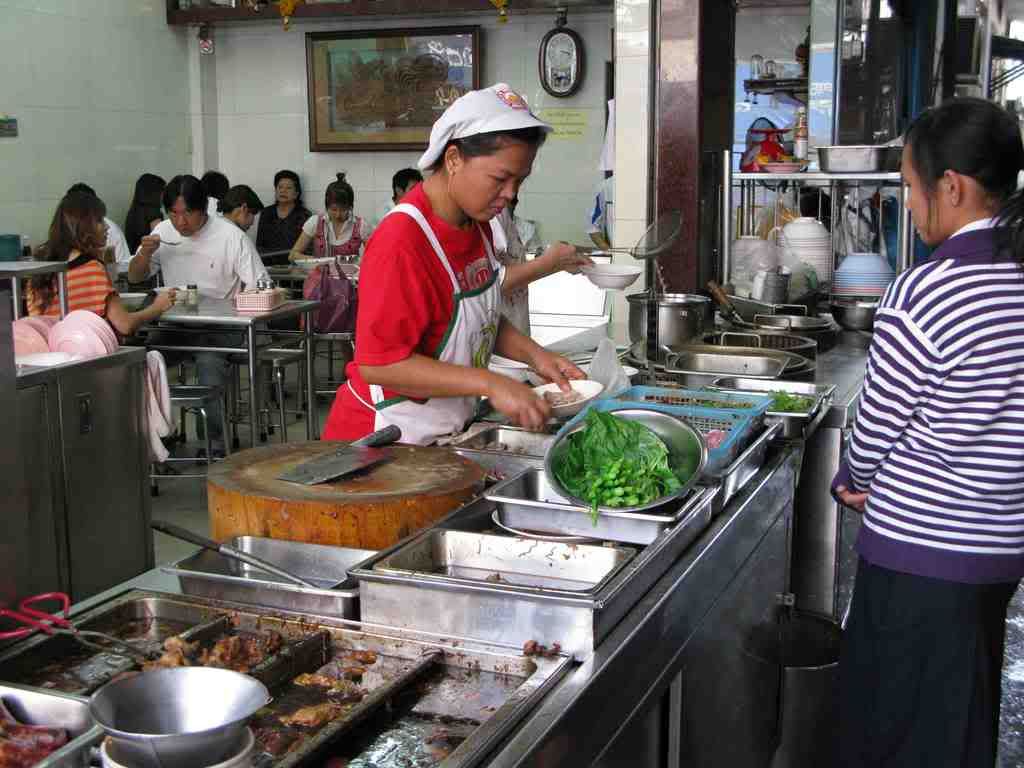
The current trend in developing countries had been returning to community-based lifestyles where the supply chain is limited among local producers and benefits are reaped by local consumers. In doing so, the impacts of products are not magnified. Community-based fast food had always been the practice in the Third World where street vendors with minimal impacts on the supply chain, using local produce and serving local produce had been in existence for ages. Yes, street vendors do have impacts on the environment and even on public health but the magnitude of its environmental impacts is only a fraction of what is expected from a major fast food chain.
It will be very difficult for fast food companies to let go of the western standard and revert back to the community-based approach to doing business, it has to become a long and steady process and like the American Auto Industry, the fast food is still in its learning stages when it comes to sustainability, lesson as an industry is never to say that you already have a PhD when you are still grappling with the hormonal changes of middle school that's a blatant lie and in terms of environmental efforts you basically call that greenwash.