The fast food industry at the moment given its rate of expansion, multinational supply chains and unrestricted pollution in terms of local emissions and effluents is truly in an unsustainable path.
Though efforts of going green in the corporate levels are being done, the programs could not totally address the magnitude of its impacts given its scale of operations.Worse thing however is the blatant branding that some fast foods are "environment-friendly" this is what we call Greenwash.
This is what I'm trying to stop, blowing up programs that are neither validated nor verified. I started this blog because I wanted change and change is necessary to achieve sustainable development.
I have decided in the long run that I do not want to spend the rest of my life working for the fast food industry. I am in the process of reading Paul Hawken's Blessed Unrest on the part of how corporations have maintained their power grip on society for them to continuously exist.
I have been attending industry conferences for quite a while and I do agree that such events can influence corporations to change their ways, but change will be a very slow process. I am not sure what goes into the minds of managers who attend these events but deep inside they are still the same people who are just going for the usual bottomline. Stand alone projects such as energy conservation, waste reduction, etc. are useless if they are simply viewed as individual programs because it does not affect a change the overall corporate views of companies.
As an EMS auditor, I would rather focus on Top Management commitment and clarity of environmental policy rather than the number of environmental projects that a company churns out. Green conferences provide a venue for sharing best practices but the focus is more on technologies and projects that a specific company has proven effective within its own context but such fora must also not fail to provide frameworks for companies who are "lost" in integrating such programs into their sustainability agenda.
Oftentimes, this becomes the root of Greenwashing, because companies focus more on promoting specific projects and programs rather than their actual commitment towards sustainable development. Third party verification to a certain degree is far more effective than blatant ads in ensuring compliance to regulations and commitment to sustainability. However, current validation criteria is still not a perfect system of validation, reliance on scientific data on the impacts requires continues studies.
Green conferences are a good thing, but it will take a lot more of these to really change how things go about...
When I was young we only get beef on Saturdays, that's how it is in developing countries if you source it out from the local market, you can only get beef once a week and most of the time its Saturday and its in limited supply, if you get to the market late well, better settle for pork then or chicken. In developing countries, it is much easier to become a locavore since what is available to you are simply local stuff.
With economic growth and the affluence that enabled us to have western standards, things have changed, we can get beef anytime of the week in meat shops at groceries and hypermarkets. Cattle raising and beef farming did try its expansion given the demand but it is still cheaper to import....so most of the beef in the frozen section comes from Australia, New Zealand and of course Brazil. With blast freeze technology, we really could not recognize whether that beef came from a top a nearby hill or halfway around the world. Now, we rarely get beef at the local market, maybe once a month but not too often.
It is the need to cheapen things up that expanded the mega-fast-food's supply chain. Producers are trying to do their best to minimize cost and this means externalizing most of it. However, acting on the short-term interest like cheap fast food right now often produces long-term results that nobody really likes. Click Here to Read More..
Is it colonial mentality that enables us to judge that imported is always better? Nowadays, the rule is imported is cheaper, especially if it came from India, China or Vietnam. But if we are told that a product came from Australia, New Zealand or Brazil, we might think otherwise, it might be better??? Where it came from is a relative term, how it came about is what matters.
When I think of Beef and Brazil combined, I think about the destruction of the Amazon Rainforest which leads to habitat loss of endemic species and loss of biodiversity and analyzing its impact further it will lead to climate change. In the Philippines, it is still not mainstream knowledge, but globally it is quite a concern and efforts by Brazil to claim sustainability in the cattle ranching industry is often criticized for being too greenwashed. The funny thing however for this case is the burger joint is not aware that it is proclaiming support against sustainable development. The truth is Beef from Brazil is Cheap and outsourcing beef from Brazil minimizes a burger joint's operating costs.
The globally expansive supply chain of the fast food is the reason why it is unsustainable. I once wrote that McDonald's insistence on the use of trawled Alaskan Pollack for its fillet-o-fish (even its insistence on carrying the Fillet-O-Fish in countries with little or no demand) not only causes impacts on the Bering Sea but also foregone benefits are accrued due to its failure to consider outsourcing fish from local aquaculture development in developing countries. It is only recently that I encountered the term locavore. If a carnivore eats meat, a herbivore eats plants, then a locavore eats local. Is localization an option for fastfood giants? However, this joint is closer to home.
I might find this not so idealistic but I just could not wait to leave the country to find a better job in the environment sector. I have lived in this country all my life, I have chosen this career path not because it pays well but because of my strong idealism and belief that there is a need to change our current ways in the market to achieve growth that is truly sustainable in the holistic sense.
However, it is quite disappointing that the once idealism I had did succumb to the monotony and bureaucracy of the system. I just submit monotonous and redundant applications for environmental permits for companies who basically have no idea what they are doing...they just need to comply as good citizens.
With the news of recession going around, conventional jobs are being lost due to the contraction of the economy. Consumers are demanding less, and output has consistently declined in the past few years and a need arises for companies in the developed world to layoff a number of their staff.
I once heard that a former colleague of mine who went abroad to work in a developed country a few months ago didn't find it hard to find a good job except that her job was taken in the expense of the locals, almost all local employees were laid off and replaced including the technical positions with migrant workers who are more educated and more value added relative to their outputs. It also helped that my former colleague have a strong background in environmental management.
With the current subsidies to develop the green industry in the first world, people like us in the third world are grabbing the opportunities. But it is also sad to note that back here at home with the global recession, reduced output also leads to lower priorities in the environment sector.
For most of my life in the developing world, fast food has been a luxury item for the rest of the population. For most families in Metro Manila, getting everyone to eat together inside a fast food outlet on a Sunday after mass is oftentimes the only luxury an average family could afford. In lower income communities, this could happen rarely in the course of the year. The opposite is true in the developing world, with a fast-paced life, fast food became a source of convenience and the consumption rate is faster.
This condition is never a reason for fast food companies to become less socially and environmentally responsible once they operate in the context of a third world economy where monitoring of environmental standards is much more lenient. However, the core structure that made a fast food successful is in terms of speed, quality food and low price is the structure that makes it unsustainable since it utilizes so much resources and produces too much wastes within the course of its life cycle.
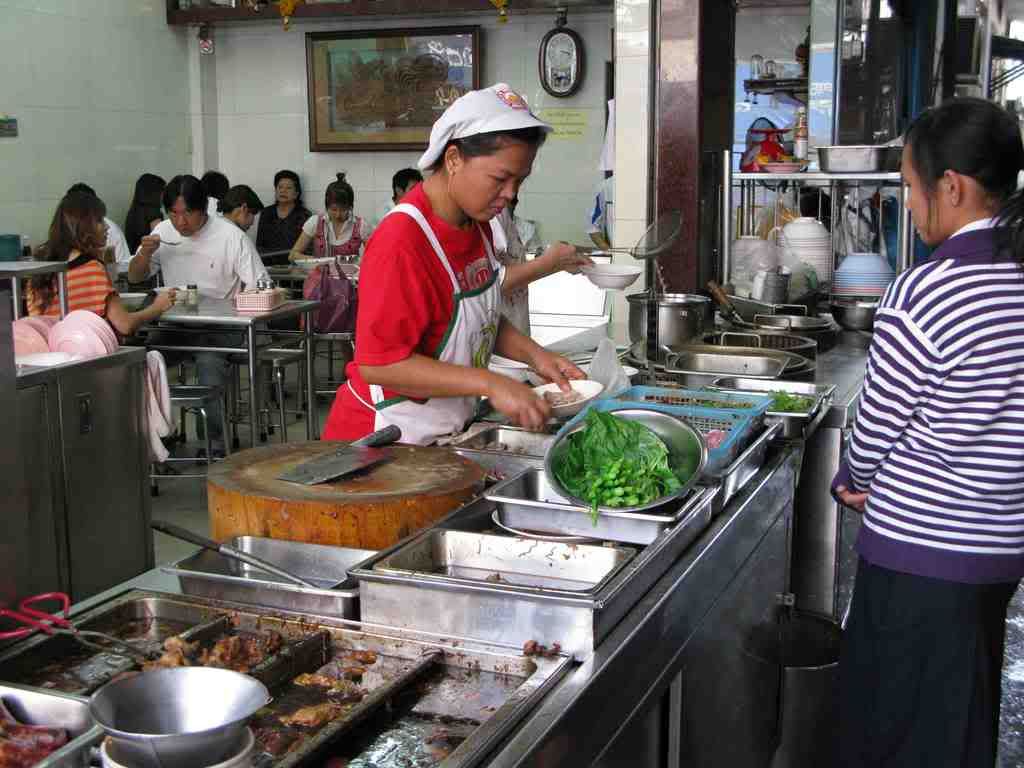
The current trend in developing countries had been returning to community-based lifestyles where the supply chain is limited among local producers and benefits are reaped by local consumers. In doing so, the impacts of products are not magnified. Community-based fast food had always been the practice in the Third World where street vendors with minimal impacts on the supply chain, using local produce and serving local produce had been in existence for ages. Yes, street vendors do have impacts on the environment and even on public health but the magnitude of its environmental impacts is only a fraction of what is expected from a major fast food chain.
It will be very difficult for fast food companies to let go of the western standard and revert back to the community-based approach to doing business, it has to become a long and steady process and like the American Auto Industry, the fast food is still in its learning stages when it comes to sustainability, lesson as an industry is never to say that you already have a PhD when you are still grappling with the hormonal changes of middle school that's a blatant lie and in terms of environmental efforts you basically call that greenwash.
A current concern in the fastfood sector is the massive use of polystyrene packaging. In the UK and most of the developed world, there is already a gradual transition from the use of polystyrene towards more sustainable packaging materials.
When McDonald's reverted back to the use of polystyrene cups for its sweet tea, it received much criticism in for its corporate social responsibility (http://www.sustainableisgood.com/)
In the Philippines, the fast food sector still has a long way to go before it can fully transition towards more sustainable packaging. I am quick to note that I am not advocating the use of paper packaging but rather a packaging system with minimal impacts to the environment in the course of its life cycle. I have decided to write this blog in the context of the Third World since the truth of the matter is economic conditions locally is totally different from the developed world.
One of the challenges of the fast food at the moment is the impact of its transition from polystyrene packaging to reusable melamine wares for dine-in customers. The transition was once hailed by civil society as the first step towards a more sustainable fast food industry, with a number of press releases. I was still in college at that time in UPLB. I remember an email forwarded to me where a civil society group boycotted the offices of McDonald's since it didn't immediately follow suit with its competitor's move to reusable wares.
However, this shift has a catch, it did reduce the volume of polystyrene packaging wastes but for the past five years according to my boss, the waste water quality of the fast food was on a decline and the DENR is now reprimanding the industry for failing to comply to the water quality standards. Technical solutions have been offered by a number of waste water treatment experts but none so far has been effective or let's say not so economically feasible given the space requirement, initial investment and maintenance cost over time.
Last December 2008, I attended a party of the Polystyrene Packaging Council of the Philippines, those invited where not merely the styro producers but a number of waste recyclers who made it a business to recycle polystyrene products. At that time, the municipality of Los Banos issued an ordinance banning the use of plastics and polystyrene packaging from all its establishments and other local governments are planning to follow suit. The DOST does support the recycling technologies but its environmental impacts should be assessed.
What I have learned is that every policy decision has an impact and my basic training in economics taught me that given this condition, we should optimize our options to come up with the solution with least cost or the least detrimental impact. Ideally, given this type of a scenario, a full Life-Cycle Analysis must be done but being in the Third World, we do not have the capacity in time and money to engage ourselves in this exercise.
Its quite hard and frustrating to live in the third world. I remember in 2002, when one of the Earth Summit agreements in Johannesburg specified that developing nations also have a responsibility in ensuring the implementation of Global Agenda 21.
Once going to Greenbelt 4 and looking at window of a high end stores, I asked the price of a patent leather pump and the saleslady told me its 56,000 pesos or around a thousand dollars. I realized that there are people who could afford them and the growth of affluence in third world is growing faster compared to the rate of efficient utilization of natural resources. I was always taught that after the Marcos era the Philippines has a very limited natural resource base.
The effort to go green in the third world is very minimal. Firms still chose to produce inefficiently, meaning externalizing their environmental impact. When I conduct trainings for company-assigned Pollution Control Officers, their mere notion is that environmental improvement can be achieved by getting and maintaining the necessary permits. But I have to ingrain in them that it is only the first step and in the long run, they must be able to change the mindset of their management by becoming more responsible through internalization of their environmental impacts.